Categorías
Nuevos productos
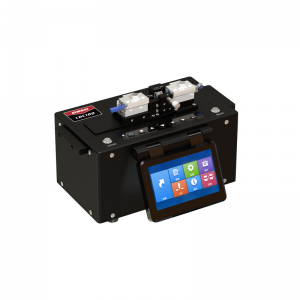
Mannaia per fibra ottica di grande diametro LDC-100 * Applicabile a fibre di diametro 80μm~600μm *Scanalatura a V della pompa del vuoto comoda per mettere la fibra *Lama durevole, durata più di 20000 volte *Archiviazione dati 4000 gruppi * Menu GUI intuitivo, facile da usare Más
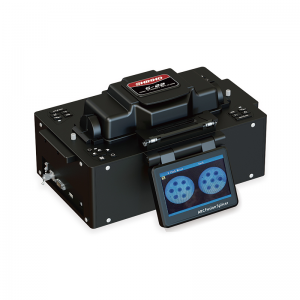
Empalmador de fusión de fibra multinúcleo S-22 La primera empalmadora por fusión de fibra multinúcleo completamente automática en China _ _ Más
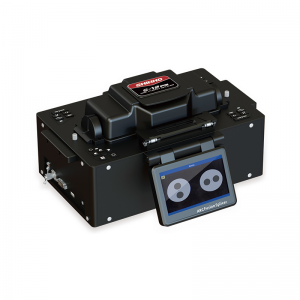
La polarización de Mantenimiento (PM) de Fibra de empalmadora de S-12 * Núcleo a la alineación, bajo el empalme de la pérdida de * Endview y Perfil de la observación y la alineación * Arco de calibración automática y empalme * PM fibra de 45 y 90 grados de alineación Más
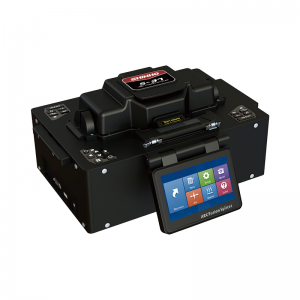
Empalmador de fusión de fibra especial S-37 LDF SHINHO S-37 es el último modelo que desarrollamos, podría empalmar un diámetro de revestimiento de fibra de 125 a 400 μm con baja pérdida de empalme. Equipamos la máquina con 3 soportes de fibra diferentes y 2 pares de electrodos de repuesto. Más
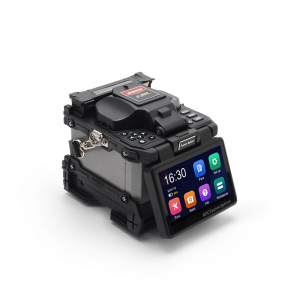
Empalmador de fusión de fibra de alineación de núcleo a núcleo x 900 Empalme de fusión de seis motores, tecnología de alineación de núcleo real a núcleo. 6s empalme, 16s calentamiento, identifique los tipos de fibra automáticamente. Usado para proyectos wan / man / telecommunication. Más
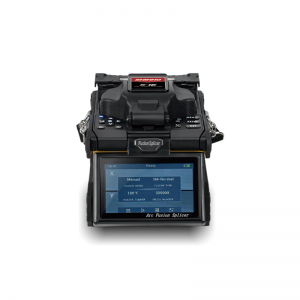
Empalmador de fusión de arco multifunción robusto s16 Diseño industrial robusto, antichoque, a prueba de polvo e impermeable. soporte multifunción para fibra desnuda, cables de conexión, cable de caída, etc. Rápido empalme y calentamiento, calibración automática de arco. Más
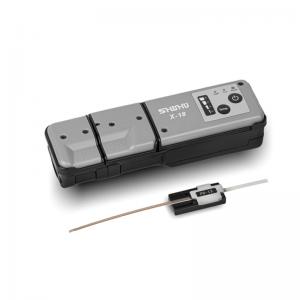
SHINHO X-18 Stripper termico in fibra di nastro Shinho X-18 Thermal Stripper è uno stripper termico manuale di nuova concezione, appositamente progettato per lo stripping termico non distruttivo della guaina di cavi a nastro fino a 12 fibre. Uno strumento buono e affidabile per il lavoro di giunzione della fibra del nastro. Más
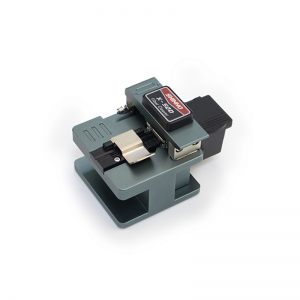
Mannaia per fibre ottiche ad alta precisione X-50D Di piccole dimensioni e leggero, facile da usare. Alta precisione e prestazioni stabili. Più di 48000 volte la durata della lama, lunghezza tagliata in fibra 5 ~ 20 mm. Materiale di alta qualità Más
Why optical fibers are hard to purchase and out of stock?
Global optical fiber demand in 2026: 750–800 million core kilometers Year-on-year growth: 28%~30%, far higher than the usual annual growth of 5%~10% Supply-demand gap: Over 100 million core kilometers with a gap rate above 16% Nearly one in six optical fibers is in short supply, leading to an overall market shortage. In short, market demand has exploded sharply.
Data center optical fiber demand in 2025: 69.6 million core kilometers Estimated demand in 2026: Exceed 100 million core kilometers, up 150% One ten-thousand-card GPU AI cluster consumes hundreds of thousands of core kilometers of optical fiber. Fiber consumption of AI data centers is 5–10 times that of traditional data centers. Hot-selling products: Ribbon fiber, multi-core fiber, high-density fiber and low-bend-loss G.657 fiber are in extreme shortage.
Accounting proportion drops to 45% in 2026 from 65% in previous years. Main applications: 5G base stations, FTTH and metropolitan area network construction. Large-scale network deployment is ongoing in China, Southeast Asia, the Middle East and Latin America.
Industrial Internet accounts for 15%, widely used in intelligent manufacturing, robots and industrial optical networks. Fiber-guided UAV industry: Single UAV consumption: 20–30 core kilometers (non-recyclable) Global annual demand: 50 million core kilometers, taking up 10% of total demand, versus only 1% in 2024.
North America: Tech giants including Microsoft, Google and Meta are building massive AI clusters, locking up most production capacity via long-term contracts. Europe, the Middle East and Southeast Asia: Rapid development of both data centers and 5G networks has led to almost zero spot fiber supply.
Common single-mode G.652D: Rise from ¥15 to ¥83–94 per core kilometer, surge over 400% Bend-insensitive G.657A2 for data centers: Rise from ¥32 to ¥240 per core kilometer, surge over 650% Ribbon fiber: Hardly available in stock with unstable prices, delivery scheduled till late 2027.
Ordinary G.652D single-mode fiber: 24–36 weeks (6–9 months) Data center ribbon fiber: Over 60 weeks (more than 1 year) Special optical fiber (G.657, polarization-maintaining fiber, MCF): Out of stock in general, delivery postponed to 2028.
· Demand side: Booming AI computing power construction triggers skyrocketing fiber consumption.
· Supply side: The expansion cycle of optical fiber preform (core raw material) lasts 18–24 months, and full production capacity still cannot meet market needs.
· Capacity occupation: Top manufacturers such as YOFC, HTGD, FiberHome and ZTT have 70%–80% of their production capacity reserved by cloud giants and telecom operators through long-term agreements.
· Hoarding behavior: Traders snap up spot goods and hold stocks for higher profits.
1. Optical fiber market demand keeps rising remarkably, and the booming trend will last at least until 2028.
2. Current fiber purchasing is difficult with long delivery cycles and high prices, which is not a short-term market fluctuation.
3. AI data center construction is the core driving force, and ribbon fiber as well as special optical fiber face the tightest supply situation.

Bienvenido a registrar el boletín de noticias si tiene algún interés en nuestros productos, lo mantendremos informado de nuestras novedades, información de productos y promociones, si las hubiera.
© Derechos de autor: SHINHO OPTICS LIMITED Todos los derechos reservados.


 español
 English
 français
 русский
 italiano
 português
 العربية
 ไทย
ไทย हिन्दी
 Indonesia
 中文
中文